In the competitive energy sector, Imperial Oil Ltd and Tourmaline Oil Corp offer interesting value propositions.
When looking at stocks in this sector, both Imperial Oil Ltd (IMO) and Tourmaline Oil Corp (TOU) have unique financial profiles. Each company has its strengths and weaknesses, making it important for investors to compare them directly. In this analysis, we’ll explore key financial metrics to see which stock offers a better valuation.
Investor takeaway: Tourmaline Oil Corp seems cheaper based on several valuation multiples, but that doesn’t automatically mean it’s a better investment than Imperial Oil Ltd.
Advertisement
Stocks in this list
Live snapshots — open any name for the full quote and Wealth Awesome price forecast.
Imperial Oil Ltd
IMO.TO
Energy
$175.00
$84.63B
1D
+1.14%
1W
-0.39%
Tourmaline Oil Corp.
TOU.TO
Energy
$60.90
$23.67B
1D
+1.82%
1W
-0.43%
Advertisement
Comparative Valuation Metrics
Tourmaline Oil Corp appears cheaper when looking at P/E, PEG, and P/B ratios, but this doesn’t necessarily mean it’s the better investment choice.
Bull case
Tourmaline Oil Corp's lower P/E and P/B ratios suggest it might be undervalued compared to its earnings and book value. Its PEG ratio also indicates strong growth potential relative to its price, making it an attractive option for investors focused on growth.
Bear case
Even with its lower valuation metrics, Tourmaline Oil Corp has a significantly lower ROE, which indicates it may not be as efficient at generating profits compared to Imperial Oil Ltd. Investors should keep this efficiency in mind when assessing potential returns.
Valuation Metrics Overview
Advertisement
The following table summarizes key valuation metrics for both Imperial Oil Ltd and Tourmaline Oil Corp:
| Metric | Imperial Oil Ltd (IMO.TO) | Tourmaline Oil Corp (TOU.TO) |
|---|---|---|
| Last adjusted close | C$175.00 | C$60.90 |
| Market cap | C$84.6B | C$23.7B |
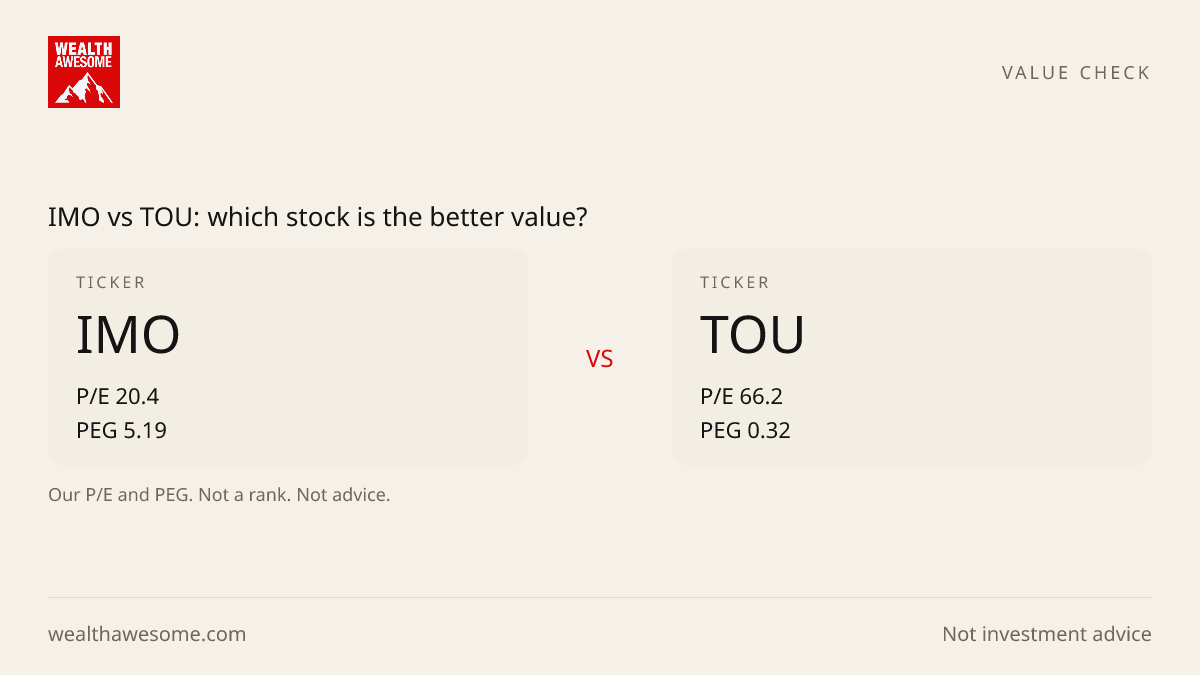
| P/E | 20.4 | 66.2 |
| PEG | 5.19 | 0.32 |
| P/B | 3.45 | 1.48 |
| Dividend yield | 1.84% | 3.34% |
| ROE TTM | 16.8% | 2.3% |
Understanding the Metrics
The P/E ratio shows how much investors are willing to pay for each dollar of earnings. Imperial Oil's P/E of 20.4 suggests a more traditional valuation, while Tourmaline's P/E of 66.2 may indicate that the market expects higher growth, even at a higher price. The PEG ratio, which considers growth, paints a more favorable picture for Tourmaline at 0.32 compared to Imperial's 5.19. However, the P/B ratio, which compares market value to book value, shows Imperial Oil at 3.45 versus Tourmaline's 1.48, suggesting that Imperial may be viewed as a more stable investment.
Best next step
Keep exploring this topic
If you want to go deeper, these are the most useful follow-up pages and tools for this topic.
Broker comparison
Best trading platforms in Canada
Compare $0-commission brokers before you act on a ticker story.
Safe cash
Best GIC rates in Canada
If the story makes you want to de-risk, compare guaranteed rates next.
HISA roundup
Best high-interest savings accounts
Keep dry powder in a no-fee savings account instead of chequing.
TFSA room
Check TFSA contribution room
Shelter the next contribution before you buy.
Advertisement

Wealth Awesome
Timely coverage of Canadian stocks, earnings, dividends, and market movers for DIY investors. Stories are checked against exchange data and public filings.
View Full Profile →✅ Reviewed by Certified Financial Professionals
This content has been reviewed by CFA® charterholders and Certified Financial Planners (CFP®) with over a decade of experience in Canadian financial markets. All information is fact-checked against official Canadian sources and regulations.
Why these credentials matter: CFA® charterholders complete 900+ hours of rigorous study in investment analysis and ethics. CFP® professionals are held to the highest standards of financial planning competency and fiduciary duty in Canada.
⚠️ Professional Disclaimer
This content is for educational purposes only and should not be considered personalized financial advice. While our team brings professional expertise, individual circumstances vary. For personalized guidance, consult with a qualified financial advisor, tax professional, or mortgage specialist.