Your family is growing, congratulations! If you're like most new moms, you're probably wondering how the arrival of your little one will impact your finances.
Sure, you'll get some money from the government, but it's not always enough to cover all of your expenses.
According to the General Social Survey (GSS) on Family, 2.3 million (80%) Canadians who were paid workers or self-employed took a form of paid leave (such as maternity, paternity leave, parental leave, vacation, employer program) or unpaid leave from their job between 2012 and 2017 after the birth or adoption of a child.
Advertisement
While the maternity leave program is a great advantage, many families wonder how they will do with a decrease in income.
After extensive research, I’ve learned some great tips on how to make money on maternity leave in Canada.
How much can you earn while on maternity leave?

Government program
The first step is to set up your government maternity payments. The government offers a variety of programs and benefits to help parents during maternity and paternity leave.
These programs and benefits can help ease the financial challenge of taking time off work to care for a new child. Both EI maternity and parental benefits are taxable.
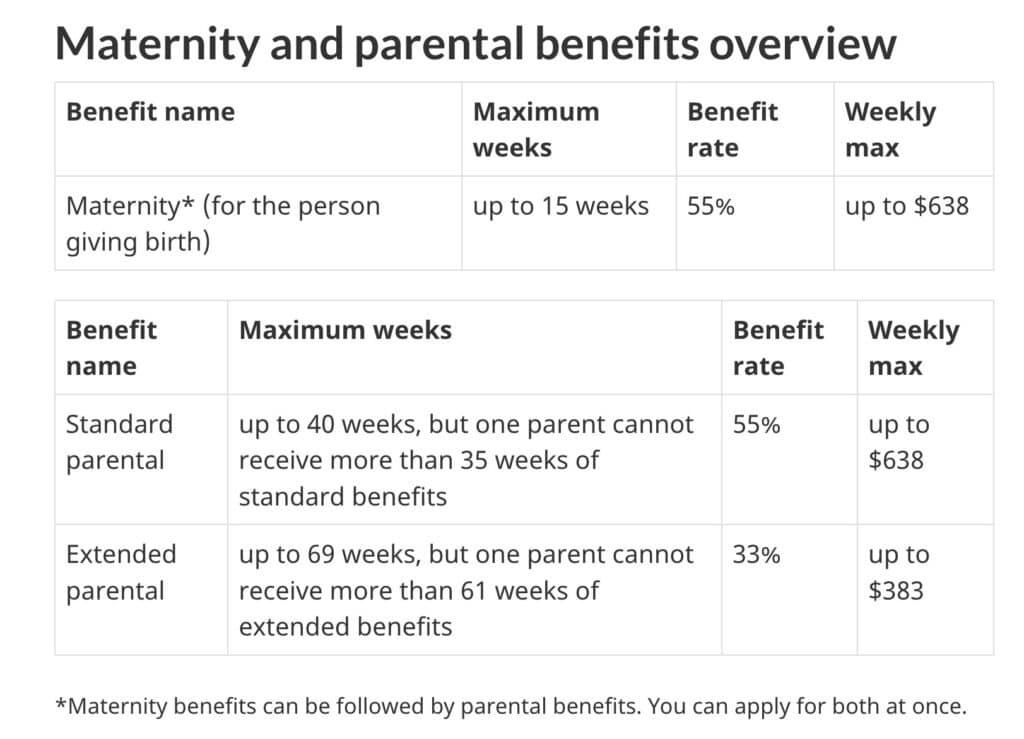
In Canada, EI maternity benefits are available to mothers who have stopped working due to pregnancy, childbirth or adopting a child. Mothers can receive up to 15 weeks of EI maternity benefits. To be eligible for these benefits, mothers must have worked at least 600 hours in the 52 weeks before their leave began.
There is a two-week waiting period before any benefits are paid. After that, benefits for maternity leave are paid out at a rate of 55% of the parent’s average weekly earnings, up to a maximum of $537 per week.
EI parental benefits are available to both mothers and fathers who have stopped working to care for a newborn or newly-adopted child. Parents can receive up to 40 or 69 weeks of EI parental benefits.
To be eligible for these benefits, parents must have worked at least 600 hours in the 52 weeks before their leave began.
If you don't meet this work requirement, you may still be eligible for parental leave benefits if you are self-employed or if you are a commission-based employee. Your eligibility will be determined by Service Canada.
You can use this calculator to get an estimate of your benefits.
For more information on these programs and benefits, visit the Government of Canada website.
Company program
There are a number of different company programs for maternity leave that can help to supplement your income while you're out on leave.
Many companies now offer top-up payments to employees on maternity leave, which can help to bridge the gap between your regular income and EI benefits.
Some companies also offer extended health benefits coverage for new moms, which can help with the costs of things like diapers, formula, and other necessary baby items.
Additionally, many companies offer flexible return-to-work programs that can help you ease back into the workforce after your leave.
If you're pregnant or planning to become pregnant, be sure to check with your employer about what type of maternity leave benefits they offer.
Can you earn extra money while on maternity leave?
In short, Yes! If you're looking for ways to earn extra money while on maternity leave in Canada, you're in luck. There are several options available to you, depending on your skills and interests.
I’ve been working online while travelling the world since 2019, and have found many ways to make money online in Canada.
1. Freelance

Level of challenge: Low
Income Potential: Medium
Perhaps the easiest way to make some extra cash is to freelance. If you have a skill that you can offer clients – like writing, design work or web development – there's a good chance someone is looking for someone just like you.
There are many websites and online platforms such as Fiverr or Upwork that can help you find work.
You can also reach out to your network of contacts to see if anyone needs your services.
2. Online store

Level of challenge: Medium
Income Potential: High
Another way to make money on maternity leave is to sell products online. Whether you're selling handmade items or used clothing, there are many ways to make money through online sales.
If you’re feeling extra creative, you can venture into content creation. Many mompreneurs have created profitable side hustles by selling digital products like ebooks, guides, courses and stock photography.
You can set up an online store through a platform like Shopify, or you can sell items through a marketplace like Etsy or Amazon.
3. Blog

Level of challenge: Low
Income Potential: High
There are many ways to make money on maternity leave, and blogging about your interests, hobbies or area of expertise is one of them.
By sharing your knowledge and experience, you can attract an audience that may be interested in learning more about these topics.
If you're out of ideas, pregnancy and motherhood is a popular niche, so that's a great place to start.
And, if you monetize your blog effectively, you can earn an income from it, namely through advertising and affiliate marketing.
Clawback on Income during Maternity Leave
If you're thinking about ways to make money while on maternity leave, there are a few things to keep in mind.
The government applies a clawback on maternity benefits, which means that if you make over a certain amount of money while on leave, you will have to pay back some of your benefits.
If you earn income while receiving EI benefits, you will be required to repay $0.50 on every dollar earned, up to 90% of your average weekly earnings.
This means that if you earn more than 90% of your average weekly earnings, you will need to repay any EI benefits received for that period.
However, this clawback only applies to income from work – so if you have other sources of income, such as dividends, capital gains or rental income, you will not be penalized on your benefits.
Maternity leave is a great time to learn a new skill, while your little one is asleep, learn how to start investing to secure a a strong financial future for yourself and your family.
Additionally, consider getting paid in cash or delaying invoicing and getting paid until after your benefits are done to avoid any unnecessary clawback.
Conclusion
Maternity leave doesn't have to mean financial insecurity. There are many ways to make money while you're at home with your new baby. Get creative and see what you can achieve.
Once your baby arrives, you will want to dedicate most of your time to your bundle of joy for the first few months.
The best way to ensure a smooth transition is to be prepared, get ahead on funding your leave by saving, so check out these 61 awesome ways to save money in Canada.
Best next step
Keep exploring this topic
If you want to go deeper, these are the most useful follow-up pages and tools for this topic.
Tax planning
Estimate your take-home pay first
Use the tax calculator before choosing software, moving cash, or making a savings plan.
Banking next step
Compare high-interest savings accounts
Move from banking basics into current cash rates and safer places to park your money.
Savings tool
See how compound growth adds up
Turn a practical money question into a long-term plan with a quick growth projection.
Advertisement
7 stocks to buy and hold forever
Proven winners for income investors — blue-chip dividend stocks to hold for decades.
Get the FREE Report
Christopher Liew, CFA, CFP®
Christopher is the founder of Blueprint Financial and a CTV News personal finance columnist. As a dual-designated CFA charterholder and Certified Financial Planner (CFP®), he helps Canadians reduce financial stress through clear, customized financial plans.
View Full Profile →✅ Reviewed by Certified Financial Professionals
This content has been reviewed by CFA® charterholders and Certified Financial Planners (CFP®) with over a decade of experience in Canadian financial markets. All information is fact-checked against official Canadian sources and regulations.
Why these credentials matter: CFA® charterholders complete 900+ hours of rigorous study in investment analysis and ethics. CFP® professionals are held to the highest standards of financial planning competency and fiduciary duty in Canada.
⚠️ Professional Disclaimer
This content is for educational purposes only and should not be considered personalized financial advice. While our team brings professional expertise, individual circumstances vary. For personalized guidance, consult with a qualified financial advisor, tax professional, or mortgage specialist.