CIBC Investor's Edge
Transfer your investments to CIBC Investor's Edge and get rewarded with an offer of up to $3,000.
- ✓$6.95 flat-rate commissions
- ✓Backed by Big Five bank security
- ✓Transfer bonus offer up to $3,000
Have you ever wondered what it would be like to see with perfect clarity? What if you could wake up and see the numbers on your alarm clock without squinting or reaching for your glasses first?
LASIK eye surgery involves cutting and reshaping the cornea of your eye to improve irregularities that cause poor vision. It typically costs between $1,500 and $3,000 per eye, depending on the procedure you choose, the surgical centre you go to, and other factors.
Below, I'll break down the most common laser eye surgery procedures in Canada, list some of the potential side effects, and give you a ballpark price range, so you can see which best fits your needs.
How Much Does Laser Eye Surgery Cost In Canada?
Laser eye surgery is an alternative to corrective eyewear. Unlike glasses or contacts, which modify how light refracts into your eyes, laser surgery physically modifies the surface of your eye with the goal of long-term vision correction.
Laser eye surgery costs can vary depending on the health of your eye, your budget, and the procedure you choose. Here's a quick list with the average cost of LASIK by procedure:
| Procedure | Cost Range (Per Eye) |
|---|---|
| Photo-Refractive Keratectomy (PRK) | $1,000 - $2,000 |
| Traditional LASIK Surgery | $1,500 - $3,000 |
| LASEK Eye Surgery | $1,500 - $3,000 |
| Epi-LASIK Surgery | $1,500 - $3,000 |
| Bladeless LASIK | $2,000 - $3,000 |
| Custom Wavefront LASIK Surgery | $2,000 - $4,000 |
Before any LASIK or laser eye surgery procedure, you'll need to undergo a complete visual exam to evaluate whether or not you're a good candidate for the surgery. This may be included in the procedure or may be billed separately, depending on the cost structure of various laser eye surgery centres.
It's also worth noting that LASIK procedures can come with unexpected "hidden costs," such as prescribed eye drops or having to take time off of work while your eyes recover (usually a week or two).
- Related Reading: How Much Do Dentures Cost In Canada?
How Does Laser Vision Correction Work?
LASIK and other forms of laser eye surgery are forms of refractive surgery that use laser technology to correct nearsightedness and other vision issues. A close examination of your eye's surface will reveal any refractive error that could result in poor vision.
Once the error is detected, the eye surgeon uses a combination of a precision blade and/or an excimer laser to correct vision in both eyes.
Common LASIK Surgery Procedures
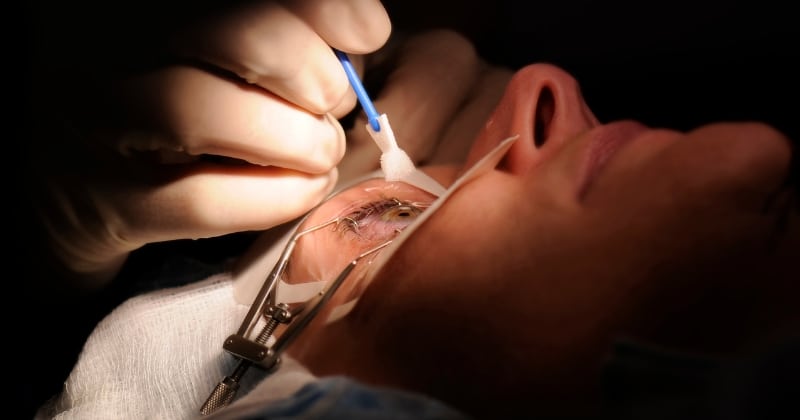
Now that you have a general idea of how much LASIK eye surgery costs in Canada, let's take a quick look at some of the most common vision correction procedures offered by surgical centres.
While your budget may determine the procedure you go choose, the surgeon may also recommend one procedure over another, depending on the health of your eyes.
With your vision on the line, I recommend going with your surgeon's recommendation, as this may result in fewer complications, such as:
-
Dry eyes
-
Red eyes
-
Halos and blurred vision
-
Dizziness
-
Headaches
These are all common short-term side effects of laser eye surgery. However, choosing the correct procedure can help prevent these from developing into long-term complications.
1. Photo-Refractive Keratectomy (PRK Surgery)
- Average Cost: $1,500 - $3,000 per eye
Canada approved using an excimer laser for PRK eye surgery in 1991, making it the oldest form of laser eye surgery. Despite how long it's been around, PRK is still one of the most popular procedures due to its simplicity.
In PRK, the epithelium (a thin protective layer covering the cornea) is completely removed using a precision blade. This exposes the cornea, which is then targeted with an excimer laser.
The laser vaporizes corneal errors, resulting in a more even surface. Once the surgery is complete, a "bandage" contact lens is placed over the cornea while the protective epithelium layer grows back (which takes three to seven days).
Pros
- Simple procedure
- Low cost
- Time-tested procedure that's been around for over 30 years
Cons
- The epithelium layer is completely removed, resulting in a longer healing process
2. Traditional LASIK Surgery
- Average Cost: $1,500 - $3,000 per eye
LASIK treatment is very similar to PRK and involves the same process of removing the epithelium layer and using a precision laser to modify the corneal tissue. The main difference between the two procedures is in how the epithelium is treated.
In PRK, the epithelium is completely removed and disposed of. This layer naturally heals and grows back on its own.
In LASIK, the epithelium is left partially attached with a "hinge." Once the laser surgery is complete, the original epithelium flap is replaced. This can result in a quicker healing time. However, it can also cause flap-related complications in some patients.
Pros
- Quicker healing time
- Around the same cost as PRK
Cons
- Can cause flap-related complications in some patients
3. LASEK Procedure
- Average Cost: $1,500 - $3,000 per eye
LASEK is a nearly identical procedure to LASIK. However, the LASEK procedure doesn't involve the complete removal of the epithelium or the creation of a "flap."
Instead, an alcohol-based solution is used to loosen the epithelial layer. This layer is then pushed to the side using a circular precision blade, after which the excimer laser is used to modify corneal tissue.
Once the surgery is complete, the epithelial layer is pushed back into place. The only downfall is that it can result in longer healing times and postoperative pain. LASEK is a slightly more delicate procedure than LASIK and is best suited to individuals with thin corneas or who suffer from other corneal issues.
A variation of LASEK is epi-LASIK.
Instead of using an alcohol-based solution, an epi-keratome tool slides between the cornea and the epithelial layer. Then, suction is applied, which slightly separates the epithelial layer from the cornea, allowing the laser to pass through. Once the procedure is complete, suction is removed from the epithelial layer allowing it to drop back over the cornea.
Epi-LASIK is a bit safer and results in less pain and fewer post-surgery complications.
Pros
- Around the same cost as LASIK
- Better suited to those with thin corneas
Cons
- Longer healing time than LASIK
- Can result in more pain after surgery
4. Femto-LASIK Surgery (Bladeless LASIK)
- Average Cost: $2,000 - $3,000 per eye
Bladeless LASIK is an improved version of LASIK that's a great alternative for those who don't like the idea of a blade near their eyes. Instead of using a blade to create a corneal flap before laser modification, a high-tech femtosecond laser is used to create the corneal flap.
Femtosecond laser cuts are more precise than blade cuts and can result in fewer postoperative complications. The one downside is that these procedures can cost slightly more.
Pros
- More accurate cuts create fewer complications
- Good for those who don't like the ideas of blades near their eyes
Cons
- Can cost a bit more than traditional LASIK
5. Wavefront-Guided LASIK (Custom LASIK)
- Average Cost: $2,000 - $4,000 per eye
Wavefront-guided LASIK is one of the [latest innovations](https://stanfordhealthcare.org/medical-treatments/l/laser-vision-correction/procedures/wavefront-lasik.html#:~:text=Custom%20LASIK%20involves%20measuring%20the,to%20your%20individual%20visual%20system.\) in corrective eye surgery. Traditional LASIK identifies vision errors by scanning the surface of the patient's eyes. Wavefront technology uses a special laser to scan the whole eye and create a 3D model.
Contoura (topography-assisted LASIK) is a similar procedure that utilizes 3D modelling.
These procedures help the surgeon better identify errors. Using the 3D model, the surgeon will then develop a custom LASIK procedure that best fits your overall eye health.
While more advanced, custom LASIK is also one of the most expensive corrective surgeries.
Pros
- Creates a detailed 3D model of your eye
- Allows surgeons to customize LASIK for your overall eye health
Cons
- Most expensive LASIK procedure
FAQs About Lasik Surgery In Canada
Here are a few quick answers to some of the most commonly asked questions regarding LASIK eye surgery in Canada.
Is LASIK Eye Surgery Safe?
LASIK is generally safe and side effects are usually short-lived. However, complications can arise. You can reduce your risk of complications by choosing a good surgeon and following proper post-operative care procedures.
Is LASIK Surgery Better Than Contact Lenses?
Contact lenses can be inconvenient and must constantly be replaced, which can make long-term LASIK vision correction appealing. However, contact lenses have a lower risk factor than LASIK as they can always be removed and changed for a better prescription.
Is LASIK Eye Surgery Covered By Health Insurance?
Corrective laser eye surgery typically is NOT covered by health insurance plans, meaning you'll need to pay out of pocket or apply for financing.
Is LASIK surgery permanent?
Yes, LASIK provides long-lasting results for most people, although some may need enhancements or reading glasses as they age.
What is the best age to get LASIK in Canada?
The ideal age is between 25 and 40 when your vision has stabilized, but eligibility depends on your overall eye health.
Can LASIK fix astigmatism?
Yes, modern LASIK techniques, including wavefront-guided procedures, can effectively correct astigmatism in many cases.
Conclusion - Is LASIK Surgery Worth It?
If contacts and glasses are no longer a viable solution and you're looking for a long-term corrective procedure, then LASIK can help your vision by permanently altering the surface of your eye and fixing incorrections.
However, LASIK isn't covered by health insurance and can come with unexpected costs and side effects. Before you jump into it, I'd encourage you to weigh your options and consult an optometrist who can analyze your eye health.
Your dental health is just as important as your vision. Check out my list of the best dental insurance plans in Canada next!
Best next step
Keep exploring this topic
If you want to go deeper, these are the most useful follow-up pages and tools for this topic.
Tax planning
Estimate your take-home pay first
Use the tax calculator before choosing software, moving cash, or making a savings plan.
Banking next step
Compare high-interest savings rates
Move from banking basics into current cash rates and safer places to park your money.
Savings tool
See how compound growth adds up
Turn a practical money question into a long-term plan with a quick growth projection.
Advertisement
7 stocks to buy and hold forever
Proven winners for income investors — blue-chip dividend stocks to hold for decades.
Get the FREE Report
Christopher Liew, CFA, CFP®
Christopher is the founder of Blueprint Financial and a CTV News personal finance columnist. As a dual-designated CFA charterholder and Certified Financial Planner (CFP®), he helps Canadians reduce financial stress through clear, customized financial plans.
View Full Profile →✅ Reviewed by Certified Financial Professionals
This content has been reviewed by CFA® charterholders and Certified Financial Planners (CFP®) with over a decade of experience in Canadian financial markets. All information is fact-checked against official Canadian sources and regulations.
Why these credentials matter: CFA® charterholders complete 900+ hours of rigorous study in investment analysis and ethics. CFP® professionals are held to the highest standards of financial planning competency and fiduciary duty in Canada.
⚠️ Professional Disclaimer
This content is for educational purposes only and should not be considered personalized financial advice. While our team brings professional expertise, individual circumstances vary. For personalized guidance, consult with a qualified financial advisor, tax professional, or mortgage specialist.