CIBC Investor's Edge
Transfer your investments to CIBC Investor's Edge and get rewarded with an offer of up to $3,000.
- ✓$6.95 flat-rate commissions
- ✓Backed by Big Five bank security
- ✓Transfer bonus offer up to $3,000
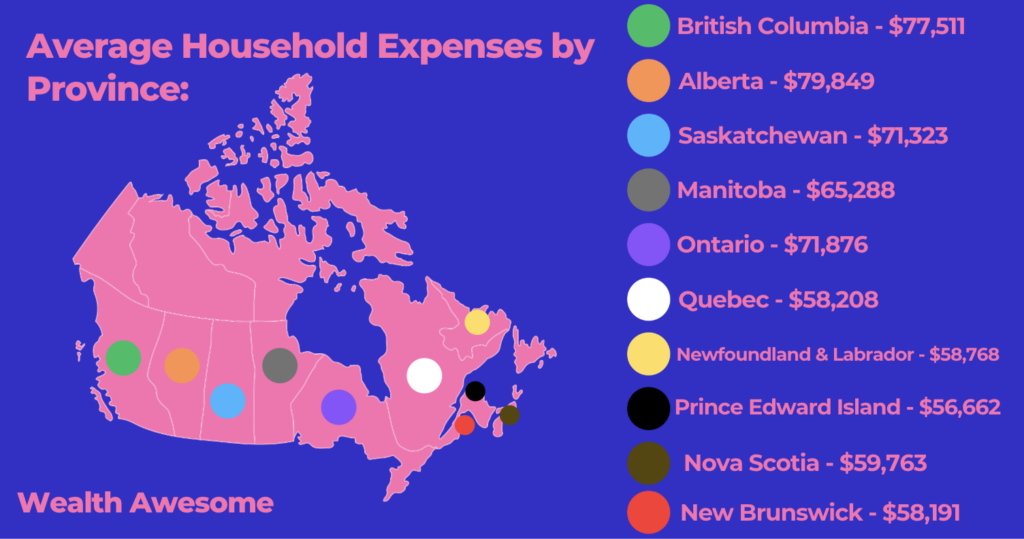
What are the average household expenses by province in Canada? According to Statistics Canada’s most recent data from 2022, the average household spent $76,168 on goods and services (excluding income tax, pensions, and charitable donations).
Albertans continue to be the biggest spenders, with average spending at $88,648 per household, while Prince Edward Island remains the most frugal, with spending at $62,298.
British Columbia households still spend the most on shelter, averaging $25,401 annually.
What does the Average Household Spend on Food and Groceries in Canada?
What Does the Average Household Spend on Food and Groceries in Canada?
Food remains one of the largest household expenses. In 2022, the average Canadian household spent $11,347 on food:
-
$8,121 on food purchased from stores
-
$3,226 on food purchased from restaurants
This reflects the continued rise in food prices across Canada due to inflation and supply chain pressures.
What does the Average Household Spend on Shelter?

Shelter is the single largest household expense in Canada. In 2022, the average household spent $22,716 on shelter:
-
$20,841 on principal accommodation (mortgage/rent, property taxes, utilities)
-
$1,875 on other accommodation (hotels, motels, and other travel housing)
What does the Average Household Spend on Transportation?
Transportation remains the second-largest household expense. In 2022, the average Canadian household spent $14,221 on transportation, which includes vehicle purchases, gas, insurance, and public transit.
Average Household Expenses on Household Operations
Canadians spent $6,159 on household operations in 2022. This category includes:
-
Communications (internet, phone, cable)
-
Furniture and major appliances
-
Small equipment and tools
Average Household Expenses on Clothing and Accessories

Spending on clothing and accessories averaged $3,697 per household in 2022, reflecting a post-pandemic resurgence in apparel and footwear spending.
Other Household Costs
Other significant household expenses in 2022 include:
-
Health care: $3,024 (prescriptions, personal care, private insurance premiums)
-
Recreation: $3,021 (sports equipment, gym memberships, streaming services)
-
Education: $1,804
-
Tobacco, alcohol, and cannabis: $2,051
-
Games of chance: $205
-
Reading materials: $181
-
Miscellaneous: $2,073
How to Improve Your Spending Habits in Canada Using This Data
This breakdown of expenses provides some valuable insight into how to improve your spending and saving habits in Canada.
Focus on the Big Three Expenses
Look at improving on three of the biggest expenses: Food, shelter, and transportation.
Food

Canadians spend $10,311 per year on food. Here are a few ways to save on food costs:
-
Meal prep – You can prep meals for a few days at a time, to make it super convenient to grab food and go. Not only do you save money, but you will probably eat way healthier also!
-
Host meals or barbecues at your own place, or at a friend’s place instead of going out to eat. You still get to socialize and save a lot of money also.
-
Have fun cooking: Look up new easy recipes, take a cooking class, and try cooking with a friend.
-
Substitute fun things for restaurants: If you really need to get out of the house and socialize, how about a walk outside, or go to a cafe instead of a restaurant? There are a million other fun things to do than go to overpriced restaurants.
-
Look up ways you can save on groceries in Canada.
-
Find different ways you can save on dining out, whether it’s going less frequently, or choosing better places with deals to go to.
Shelter / Housing

$20,200 is the average amount spent by Canadians on housing. A few ways to save on shelter and housing:
-
Live further from the city core: downtown rent is usually a lot more, so try to live outside the core. Be mindful that depending on where you work, this might increase transportation costs.
-
Look for a new place in the wintertime: Demand is usually lower because people don’t want to move in the winter, so homeowners have more trouble renting out their units.
-
Negotiate when re-signing a lease: If you’ve been a good tenant, your landlord might not want to lose you. Try to ask for 10% less to start and see if they would consider negotiating down. It doesn’t hurt to try!
-
Sublet your place: If you’re gone for a while, consider subletting your place so you can save on rent costs.
-
Negotiate better mortgage rates: If you’re up for new mortgage rates, look outside of the big banks. Pit multiple mortgage brokers against each other for the best rates, they have access to hundreds of lenders and work on commission so are motivated to get you the best deal.
-
Learn to use Airbnb: Whenever you need to leave the city, you could be using your home as an income-generating asset. It’s a must if you live in a high tourist area, you could be missing out on a lot of money!
-
Buy below your means: Even though you’re approved for a maximum amount for a mortgage, it doesn’t mean you should take that amount. By buying lower than the maximum, you leave yourself some wiggle room to spend on other areas of your life.
Transportation

Canadians spend on average of $12,737 per household on transportation. Here are a few ways to save on that expense:
-
Take your time to buy a vehicle: Don’t wait for your current vehicle to die before shopping for a new one, so you’re not too desperate.
-
Negotiate insurance – if you live in a province where you can buy car insurance from a private provider, contact multiple brokers and shop around online for the best rates. There’s a big difference in price for the exact same type of product.
-
Buy used, and look for good deals: The first few cars that I bought, I owned them for over a year and sold them for at least the same amount that I purchased them for. If you buy new, you will not get even close to what you paid for, since the first few years of depreciation on your car are the heaviest.
-
Avoid buying premium fuel cars: Have you seen gas prices lately? Premium fuel is super expensive now!
-
Aim for a three to five-year-old used vehicle: The average new car loses between 20-25% of its value in the first year alone. By buying a car that’s a few years old, you can still not worry much about maintenance and have a relatively new car.
Conclusion
Looking at the expense data can tell us a lot about the spending habits of Canadians. By figuring out what Canadians spend the most money on every year or month, you can use it to cut down on what you’re spending also.
Frequently Asked Questions (FAQs)
1. What is the average household spending in Canada?
As of 2022, the average Canadian household spent $76,168 on goods and services, excluding taxes and charitable contributions.
2. Which province has the highest household expenses?
Alberta has the highest average household expenses at $88,648 per year.
3. What are the top three household expenses in Canada?
Shelter, transportation, and food are the three largest expense categories for most Canadian households.
4. How much do Canadians spend on housing?
In 2022, Canadians spent an average of $22,716 annually on shelter, including rent/mortgage, utilities, and property taxes.
5. What’s the average cost of food per household in Canada?
The average household spent $11,347 on food in 2022, including groceries and dining out.
6. How can I reduce my household expenses in Canada?
You can reduce spending by meal planning, cutting housing costs (e.g., downsizing or renegotiating rent), and using public transportation or carpooling.
7. Is household spending increasing in Canada?
Yes, household spending has generally been rising due to inflation and increased costs of essentials like housing, food, and transportation.
8. Are these expenses before or after taxes?
These expenses reflect spending on goods and services and do not include income taxes, pension contributions, or donations.
Best next step
Keep exploring this topic
If you want to go deeper, these are the most useful follow-up pages and tools for this topic.
Tax planning
Estimate your take-home pay first
Use the tax calculator before choosing software, moving cash, or making a savings plan.
Banking next step
Compare high-interest savings rates
Move from banking basics into current cash rates and safer places to park your money.
Savings tool
See how compound growth adds up
Turn a practical money question into a long-term plan with a quick growth projection.
Advertisement
7 stocks to buy and hold forever
Proven winners for income investors — blue-chip dividend stocks to hold for decades.
Get the FREE Report
Christopher Liew, CFA, CFP®
Christopher is the founder of Blueprint Financial and a CTV News personal finance columnist. As a dual-designated CFA charterholder and Certified Financial Planner (CFP®), he helps Canadians reduce financial stress through clear, customized financial plans.
View Full Profile →✅ Reviewed by Certified Financial Professionals
This content has been reviewed by CFA® charterholders and Certified Financial Planners (CFP®) with over a decade of experience in Canadian financial markets. All information is fact-checked against official Canadian sources and regulations.
Why these credentials matter: CFA® charterholders complete 900+ hours of rigorous study in investment analysis and ethics. CFP® professionals are held to the highest standards of financial planning competency and fiduciary duty in Canada.
⚠️ Professional Disclaimer
This content is for educational purposes only and should not be considered personalized financial advice. While our team brings professional expertise, individual circumstances vary. For personalized guidance, consult with a qualified financial advisor, tax professional, or mortgage specialist.