CIBC Investor's Edge
Transfer your investments to CIBC Investor's Edge and get rewarded with an offer of up to $3,000.
- ✓$6.95 flat-rate commissions
- ✓Backed by Big Five bank security
- ✓Transfer bonus offer up to $3,000
The Bank of Montreal (BMO) is one of the “big-five” banks in Canada and currently serves over 12 million customers across the country.
Like all other banks, BMO offers account holders the option to purchase a chequebook, which can be used to create a BMO sample check (often called a specimen cheque).
Today, I’ll explain everything that you need to know about how to get a BMO sample cheque.
I’ll also explain how to read and write a BMO void cheque, in case you’re ever asked to. Let’s take a look!
How To Get A BMO Sample or Void Cheque
1. Print one out From BMO Online Banking
You can simply log into your BMO online banking portal. Here's how you can get a PDF of your BMO sample cheque:
-
Log into your online BMO account using your username and password
-
Go to My Accounts, and click on the account where you want to receive your sample cheque.
-
Select the option for Void Cheque.
-
You'll get a PDF document that has your BMO void cheque, and you can print and download it for whatever you need.
2. Ordering A BMO Chequebook
It’s fairly easy to order a chequebook from BMO. If you have a local BMO branch nearby, you can visit the bank during normal operating hours and ask your teller to order a chequebook for you.
They’ll typically present you with a few options that vary in cheque design.
Once your chequebook order has been placed, you can expect your cheques to arrive within one to two weeks.
Since cheques are custom printed, they take a little bit longer to mail than most traditional packages, so don’t expect any overnight shipping.
Other ways to obtain a chequebook from BMO include:
-
Order through your BMO online banking portal
-
Contact a BMO representative at 1-877-225-5266
For more information, you can read BMO’s guide on how to order cheques.
After receiving your cheques, simply write VOID on the cheque in big letters.
How To Read A BMO Sample Cheque
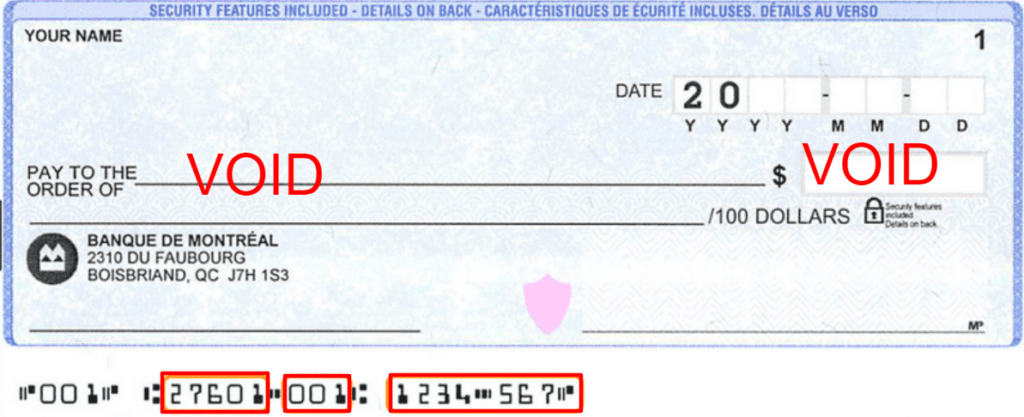
Most Canadians don’t use paper cheques very often. So, here’s a quick brush-up on how to read a BMO sample cheque, if you haven’t done so in a while.
1. Account Holder Details (Upper Left)
In the upper left-hand corner of the cheque, you’ll find your personal details, including:
-
Your legal name
-
Your mailing address
2. BMO Cheque Date (Upper Right)
On the far right-hand corner, you’ll find the date. This doesn't need to be filled out on sample cheques, but is important if you plan on paying by cheque. The amount of the cheque cannot be transferred until this exact date.
3. Payee Information (First Line)
The first line should include the full legal name of the individual or business that is being paid. You don’t have to fill this out for your BMO sample cheque, though.
4. Written Amount (Second Line)
This line should just be filled in with the word “VOID” on a BMO sample cheque. On a real cheque, this line would include the written amount of money to be transferred (i.e., “one-hundred and fifty-five dollars”).
5. Dollar Amount Box
To the right, you’ll find the dollar amount box, where the numerical value of the cheque should be written. On a BMO sample cheque, this box should be left blank, marked with $0.00, or covered with the word “VOID.”
6. Account Holder Signature (Bottom Left)
The bottom left-hand corner should feature a line allowing the account holder to sign off on the cheque. You don’t need to fill this out when writing a BMO sample cheque, though.
7. Cheque Memo (Bottom Right)
The bottom right-hand corner provides a simple line to describe the reason for the payment. This should be left blank on a BMO void cheque.
8. MICR Encoding Line (Numbers On The Bottom)
The very bottom of your BMO cheque will feature a line of numbers encoded with your bank account details. Make sure that you do not cover any of these numbers with the word “VOID.”
What Can A BMO Sample Cheque Be Used For?
If you’re signing up for an automatic withdrawal or deposit program, then you may be asked to present a BMO sample cheque along with your application. The BMO sample cheque contains important details, such as:
-
Your legal name
-
Your mailing address
-
Your bank account number
This verifies that you are, in fact, the account holder and verifies that all of your account information is correct.
This ensures that the money being deposited or withdrawn from your account is going to or coming from the correct place.
BMO sample cheques are often used for the following purposes:
-
To set up direct deposit with your employer
-
To set up automatic debits by a utility provider or credit card company
-
To make paying your rent easier
-
To set up automatic invoicing for a business
BMO Sample Cheque vs. BMO Void Cheque: What’s The Difference?
A BMO sample cheque is just a blank cheque that contains your full name and account details.
It isn’t used to transfer a specific amount of money or to pay an individual or business. It’s only used for informational purposes to verify your account details.
Sometimes, you may be asked for a BMO void cheque instead. So, what’s the difference?
There is none.
A BMO sample cheque is the same as a BMO void cheque. Sometimes, these blank cheques are also referred to as a BMO specimen cheque.
Can I Get A BMO Sample Cheque From The Bank?

If you’re asked to provide a BMO sample cheque, then you may think to walk into your closest BMO branch and ask them to provide you with a specimen cheque. Unfortunately, you cannot get a same-day BMO sample cheque from your bank.
To obtain a BMO sample cheque, you must first order a chequebook from BMO. Then, you can use one of your cheques as a void cheque.
The reason why you can’t get a cheque directly from the bank is that all cheques are custom-made and encoded using special magnetic ink that contains your personal account information.
This is the same for all other Canadian banks, regardless of whether you bank with CIBC, RBC, or others.
How To Write A BMO Sample Cheque
Writing a BMO sample cheque is incredibly easy. Once you have your chequebook, remove one cheque and write the word “VOID” across the front of it.
Whenever banks see this, they automatically know that it’s a sample cheque and that it’s not to be used for monetary withdrawals or transfers.
I also recommend writing the word “VOID” or a “$0.00” amount in the dollar amount box to prevent a would-be thief from rewriting the cheque and attempting to steal money from you.
Conclusion
That doesn’t sound so hard, right? Writing a BMO sample cheque is as easy as taking one of the BMO cheques out of your chequebook and writing the word “VOID” across the front of it.
Since sample cheques include personal information, make sure that you only give the cheque to the individual or organization that it’s intended for.
If you have a BMO account, you can also start investing in ETF portfolios. Keep reading to see my review of BMOs all-in-one ETF portfolios.
Best next step
Keep exploring this topic
If you want to go deeper, these are the most useful follow-up pages and tools for this topic.
Banking next step
Compare high-interest savings rates
Move from banking basics into current cash rates and safer places to park your money.
Safe cash option
See the best GIC rates in Canada
Compare guaranteed rates if you are choosing between keeping cash liquid or locking it in.
Savings tool
Estimate your TFSA room
Work out how much tax-sheltered room you still have before you move extra cash into savings.
Advertisement
7 stocks to buy and hold forever
Proven winners for income investors — blue-chip dividend stocks to hold for decades.
Get the FREE Report
Christopher Liew, CFA, CFP®
Christopher is the founder of Blueprint Financial and a CTV News personal finance columnist. As a dual-designated CFA charterholder and Certified Financial Planner (CFP®), he helps Canadians reduce financial stress through clear, customized financial plans.
View Full Profile →✅ Reviewed by Certified Financial Professionals
This content has been reviewed by CFA® charterholders and Certified Financial Planners (CFP®) with over a decade of experience in Canadian financial markets. All information is fact-checked against official Canadian sources and regulations.
Why these credentials matter: CFA® charterholders complete 900+ hours of rigorous study in investment analysis and ethics. CFP® professionals are held to the highest standards of financial planning competency and fiduciary duty in Canada.
⚠️ Professional Disclaimer
This content is for educational purposes only and should not be considered personalized financial advice. While our team brings professional expertise, individual circumstances vary. For personalized guidance, consult with a qualified financial advisor, tax professional, or mortgage specialist.