Do you want to add exposure to silver without owning a mountain of physical metal or going through the hassle of picking stocks?
Silver ETFs can allow you to participate in the price returns of silver throughout your investment accounts without having to actually buy it.
We’ll cover the best silver ETFs in Canada below and discuss them in more depth below.
Advertisement
How Silver ETFs Work
Silver ETFs provide a seamless avenue for those wishing to tap into the silver market without the complications of physical ownership or storage.
At their core, these instruments mirror the behaviour of traditional stock shares. Here's the twist: each share of a silver ETF corresponds to a certain quantity of silver, often denoted in ounces.
The majority of silver ETFs either physically hoard silver bullion within secure confines or invest in futures contracts that target future silver prices, not the current ones.
The latter seeks to capture the future trajectory of silver prices. An inevitable overhead with silver ETFs is the management fee. This fee, albeit a modest percentage, is deducted from the total assets managed and goes toward the operational and managerial expenses of the ETF.
Should you Invest in a Silver ETF?
Silver makes sense within portfolios in certain situations. Investors typically include silver in their portfolio to improve diversification or to try and hedge (or benefit from) against inflation. Since silver ETFs have unique features, they benefit some investors specifically:
-
Investors bullish on the price of silver
-
Individuals not looking for regular income
-
Investors looking to diversify a portfolio beyond stocks and bonds
-
Those looking to reduce the impact of inflation on portfolios
-
Investors with a high-risk tolerance
Pros and Cons of Silver ETFs
Investing in silver through an ETF comes with its pros and cons:
Pros
-
Tax benefits when investing through an account such as an RRSP or TFSA
-
Much higher liquidity than buying and selling physical silver
-
No storage costs
Cons
-
May not always be backed by physical silver
-
ETF unit values can deviate from true underlying values due to trading
-
Silver ETFs may be small in size and illiquid
-
Available for trading only during market hours
Silver ETFs in a TFSA vs RRSP (Tax Considerations)
TL;DR: Silver ETFs don’t pay income, so they work best in tax-sheltered accounts. A TFSA eliminates all tax drag, while an RRSP offers tax deferral, though there’s no income to shelter anyway.
How Silver ETFs Are Taxed
Silver ETFs don’t generate dividends or interest. Your return comes almost entirely from price appreciation, which is normally taxed as capital gains in a non-registered account.
That makes registered accounts far more efficient for holding silver exposure.
Why Silver ETFs Work Well in a TFSA
Holding silver ETFs in a TFSA is usually the most tax-efficient option:
-
No capital gains tax when silver prices rise
-
No income tax (there’s no yield anyway)
-
Ideal for volatile assets with long-term upside
Since silver can experience sharp price swings, shielding gains inside a TFSA can significantly improve after-tax returns.
Why Silver ETFs Also Fit Inside an RRSP
Silver ETFs can also be held in an RRSP, though the benefit is slightly different:
-
Any gains are tax-deferred, not tax-free
-
There’s no dividend income being sheltered
-
Withdrawals are taxed as income later
Because silver ETFs don’t generate cash flow, the RRSP advantage mainly comes from deferring taxes on eventual gains, not ongoing income.
No Withholding Tax to Worry About
Unlike U.S. dividend-paying ETFs, silver ETFs have no withholding tax issues. Since there are no distributions, cross-border tax drag isn’t a factor in either a TFSA or RRSP.
Silver ETFs vs Physical Silver: Which Is Better?
Silver exposure can be gained either through ETFs or by owning physical bullion — but the experience and costs are very different.
Liquidity
Silver ETFs trade on major exchanges and can be bought or sold instantly during market hours. Physical silver requires finding a dealer, accepting spreads, and waiting for settlement.
Storage and Insurance Costs
Physical silver must be stored securely and may require insurance. These costs are ongoing and often underestimated. Silver ETFs eliminate storage entirely, with costs embedded transparently in the MER.
Bid/Ask Spreads
Physical silver products often come with wide dealer markups, especially for small bars and coins. Silver ETFs typically have tighter bid/ask spreads, making them more efficient for frequent rebalancing.
Tax Simplicity
Tracking capital gains on physical silver can be cumbersome, especially across multiple purchases. Silver ETFs simplify tax reporting and eliminate record-keeping headaches.
Registered Account Suitability
Physical silver cannot be held inside a TFSA or RRSP. Silver ETFs can — making them the only practical option for registered accounts.
For a deeper breakdown of physical ownership, see our guide on how to invest in silver in Canada, or explore the cheapest places to buy silver bars in Canada if you prefer direct ownership.
Best Silver ETFs in Canada
1. iShares Silver Bullion ETF

-
Ticker: SVR.TO
-
Inception Date: July 15, 2009
-
Assets under Management: $99.82 Million
-
Management Expense Ratio: 0.66%
-
Investment: Silver Bullion
-
Management Style: Passive
-
Risk Rating: High
-
Distributions: Annually
-
Stock Price: $30.50
-
YTD Return: -10.11%
Blackrock’s iShares offers a silver bullion ETF in Canada under the ticker SVR.TO. SVR invests directly in physical silver and aims to offer investors the performance of silver minus any fees.
SVR has a very long performance track record and is a decently sized ETF in terms of assets under management. With regards to fees, it is more than twice as expensive as Purpose’s SBT ETF for the exact same investment.
iShares rates SVR as a high-risk investment which is a fair assessment of volatility. The ETF does not offer investors any income stream since it invests purely in silver bullion.
If SBT’s small AUM eliminates it as a silver ETF option for your portfolio, SVR is the next best-priced option.
2. Purpose Silver Bullion Fund

-
Ticker: SBT.TO
-
Inception Date: May 10, 2016
-
Assets under Management: $5.09 Million
-
Management Expense Ratio: 0.61%
-
Investment: Silver Bullion
-
Management Style: Passive
-
Risk Rating: High
-
Distributions: Annually
-
Stock Price: $32.35
-
YTD Return: -11.39%
Purpose offers one of the lowest-cost ETFs in this space, investing directly in physical silver bullion. The fund holds silver in 1,000-ounce international bars or minor amounts of silver certificates.
SBT has a medium-length performance track record and is a tiny ETF in terms of assets. The fund is at risk of closing down in the future if it is unable to attract additional capital and should be monitored.
Since the fund invests directly in silver bullion, its performance should reflect the price change in silver minus any fees. Purpose rates SBT as a high-risk investment, which is a fair assessment of the risk for silver.
SBT does not offer investors any income stream since it invests purely in silver bullion.
As one of the most inexpensive ways to invest directly in silver, SBT is a great option to consider, especially if it attracts more capital in the future.
3. Horizons Silver ETF

-
Ticker: HUZ.TO
-
Inception Date: June 24, 2009
-
Assets under Management: $27.56 Million
-
Management Expense Ratio: 0.78%
-
Investment: Silver Futures
-
Management Style: Passive
-
Risk Rating: High
-
Distributions: Annually
-
Stock Price: $27.13
-
YTD Return: -9.66%
If you are looking to invest in silver through futures, Horizons offers a silver futures ETF through HUZ. HUZ is a passive fund that tracks the Solactive Silver Front Month MD Rolling Futures Index ER.
The ETF comes with a very long performance track record and is a small ETF by AUM. Despite not owning silver physically, it comes with a relatively high MER when compared to silver bullion ETFs.
HUZ could be at risk of closing down early in the future if it is unable to attract enough assets under management.
Horizons rates HUZ as a high-risk fund, which is a good assessment of risk for investors. The fund does not pay investors income as it only invests in silver futures.
If you are looking to invest in silver futures without actually trading the contracts themselves, HUZ is an excellent replacement.
4. Horizons Betapro Silver 2x Daily Bull ETF
-
Ticker: HZU.TO
-
Inception Date: June 29, 2009
-
Assets under Management: $51.9 Million
-
Management Expense Ratio: 1.39%
-
Investment: Leveraged (2x) Silver Futures
-
Management Style: Passive
-
Risk Rating: High
-
Distributions: Annually
-
Stock Price: $75.68
-
YTD Return: -17.24%
If your appetite for risk is very high, Horizons also offers a leveraged approach to investing in silver, again through futures. HZU will offer investors twice the daily performance of silver futures and aims to return two times the return of the Solactive Silver Front Month MD Rolling Futures Index ER.
Leveraged ETFs are designed to be mainly used as trading tools and are usually not recommended as long-term investments. They can be useful for making tactical adjustments to a portfolio.
HZU has a very long performance track record and is a decently sized silver ETF in terms of assets under management. With regards to its MER, it is many times more expensive than other silver ETF choices on our list.
Relative to non-leveraged silver ETFs, which also come with a high-risk rating, HZU should be considered a very high-risk investment.
If you are looking for tactical and leveraged exposure to silver, HZU is an excellent choice for an ETF on the shelf here in Canada.
5. Horizons Betapro Silver 2x Daily Bear ETF
-
Ticker: HZD.TO
-
Inception Date: June 29, 2009
-
Assets under Management: $3.31 Million
-
Management Expense Ratio: 1.59%
-
Investment: Inverse Leveraged (2x) Silver Futures
-
Management Style: Passive
-
Risk Rating: High
-
Distributions: Annually
-
Stock Price: $3.87
-
YTD Return: -3.73%
If your appetite for risk is very high and you are bearish on silver prices, Horizons has yet another solution on the ETF shelf in Canada.
HZD will offer investors twice the inverse daily performance of silver futures and aims to return two times the inverse return of the Solactive Silver Front Month MD Rolling Futures Index ER. As an example, if the index returns 3% over the course of a day, HZD should return roughly -6%.
Two-times leveraged and inverse ETFs aim to return twice the inverse performance of an investment only on a daily basis. Over a longer period of time, this can be very different from twice the inverse long-term performance of a specific asset.
HZD has a very long performance track record and is a tiny silver ETF in terms of assets under management. Investors should keep a close eye on the fund’s asset level as it could be at risk of closing down early in the near future.
With regards to its MER, it is extremely high relative to other silver ETFs on our list.
Relative to non-leveraged silver ETFs, which also come with a high-risk rating, HZU should be considered a very high-risk investment. Its inverse nature also increases the fund’s risk.
If you are looking for tactical and leveraged inverse exposure to silver, HZD may be a good short-term choice to consider.
Silver ETFs vs Silver Stocks
Silver ETFs provide direct exposure to the metal’s price. Silver mining stocks add another layer of complexity — and risk.
Operating Leverage
Silver stocks can outperform silver itself when prices rise, since miners benefit from fixed costs and expanding margins. However, the reverse is also true during downturns.
Company-Specific Risk
Mining stocks introduce risks unrelated to silver prices, including:
Cost overruns
Operational disruptions
Management decisions
Political and jurisdictional risk
Silver ETFs avoid these entirely by tracking the metal itself.
When Silver Stocks Outperform
Silver mining stocks tend to outperform during strong bull markets in silver, especially when production costs are stable and prices rise rapidly.
Volatility Comparison
Silver stocks are typically more volatile than silver ETFs, making them less predictable and more sensitive to market sentiment.
Investors looking for individual company exposure can explore silver stock profiles such as:
-
Wheaton Precious Metals
-
Pan American Silver
-
First Majestic Silver
-
Hecla Mining
Silver ETFs, on the other hand, remain the cleaner choice for broad, commodity-level exposure.
When Does Silver Perform Best?
Silver’s performance is highly cyclical and tends to follow specific macroeconomic patterns.
Inflationary Environments
Silver often performs well during periods of rising inflation, as investors seek hard assets to preserve purchasing power.
Industrial Demand Cycles
Unlike gold, silver has significant industrial use — particularly in electronics, solar panels, and medical applications. Strong economic growth can increase demand and push prices higher.
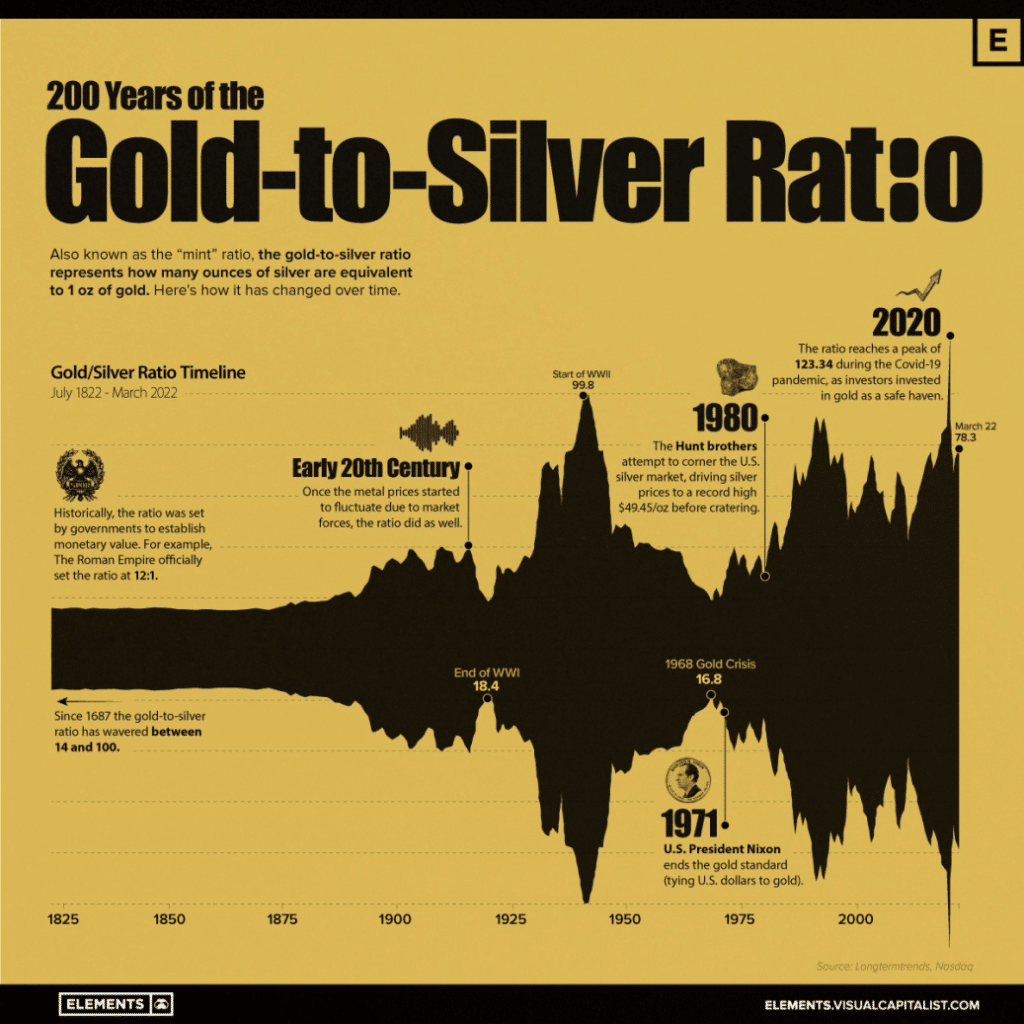
The Gold-to-Silver Ratio
The gold-to-silver ratio measures how many ounces of silver it takes to buy one ounce of gold.
-
A high ratio may suggest silver is undervalued relative to gold
-
A declining ratio often signals silver outperformance
Many investors monitor this ratio to time silver allocations more effectively.
Typical Silver Performance Scenarios
Silver tends to perform best when:
-
Inflation expectations are rising
-
Industrial demand is accelerating
-
The gold-to-silver ratio is elevated
-
Investors rotate into hard assets
Because of its volatility, silver often moves later — and faster — than gold once a trend is established.
Strategies for Including Silver ETFs in your Portfolio
A lot of investors watch the gold-to-silver ratio to try and determine the right time to invest in silver. This graphic illustrates the strategy:
Silver and other precious metals such as gold is best implemented as a small allocation of your overall portfolio. Since silver does not pay investors any income or dividends, returns are expected to come from an increase in silver price.
A typical allocation for most investors to precious metals is typically 0-10%, which includes both gold and silver. Given the volatility of these metals, especially silver, they are usually recommended for investors with a high-risk tolerance.
Investors with a lower risk tolerance should have an allocation to silver ETFs that is closer to 0%.
Investors with a higher risk tolerance may wish to aim for an allocation of 5-10% towards silver ETFs.
Are Silver ETFs a Good Investment?
Investing in silver through an ETF is a great alternative to owning the physical metal. Relative to gold, silver is worth much less per gram. This means that an equal dollar amount invested in silver (relative to gold) would mean owning a lot more of the physical metal.
Investing in a silver ETF eliminates the need to store silver, as well as the need to buy and sell through a precious metal dealer or store. Silver has a lot of industrial applications, making it less defensive than gold.
Given its many uses, silver is more closely linked to the overall economic cycle and is usually more volatile than gold. It is usually a great niche investment to own in your portfolio as a diversifier, typically in small percentages (1-5%).
Be mindful that silver does not pay you any income for holding it and actually charges ETF investors a store cost (usually embedded in the fees). In almost all cases, your returns from investing in silver will come from the metal appreciating in value.
How to Buy the Best Silver ETFs in Canada
Buying a silver ETF in Canada is a straightforward process, but choosing the right account and platform can make a meaningful difference in costs and long-term returns.
Step 1: Choose the Right Account Type
Silver ETFs can be purchased in several account types:
-
TFSA – Often the most tax-efficient option since gains are completely tax-free
-
RRSP – Suitable if you want to defer taxes on future gains
-
Non-registered account – Capital gains are taxable, making this the least efficient option
Because silver ETFs do not pay income, most long-term investors prefer holding them inside a TFSA or RRSP.
Step 2: Select a Canadian Brokerage
To buy a silver ETF, you’ll need access to a Canadian investment platform that supports ETF trading. Most major brokerages allow you to purchase silver ETFs listed on the TSX.
When comparing platforms, consider:
-
Trading commissions
-
ETF availability
-
Ease of use
-
Account minimums
Investors new to ETFs may benefit from platforms that offer commission-free ETF purchases, while more experienced investors may prioritize advanced trading tools.
Step 3: Decide Between Bullion, Futures, or Leveraged Exposure
Before placing a trade, decide what type of silver exposure you want:
-
Physically backed silver ETFs track the price of silver bullion
-
Futures-based silver ETFs follow silver futures contracts and may behave differently over time
-
Leveraged silver ETFs amplify daily price movements and are typically used for short-term strategies
Long-term investors generally stick with physically backed silver ETFs.
Step 4: Place Your Trade
Once you’ve chosen an ETF, you can place a buy order during market hours using either:
-
A market order (executes immediately)
-
A limit order (executes at a specific price)
Limit orders are often preferred for silver ETFs due to their volatility.
Step 5: Monitor and Rebalance
Silver ETFs are usually held as a small portion of a diversified portfolio. Over time, large price swings may require rebalancing to maintain your target allocation.
Most investors rebalance annually or when silver exposure drifts significantly from their original plan.
Conclusion
The process of investing in silver becomes much simpler when using silver ETFs. Canadian silver ETFs can vary in terms of features – make sure to do your due diligence ahead of time.
Before buying a silver ETF, make sure that you are aware of the different ways in which you can add ETFs to your investment accounts.
Best next step
Keep exploring this topic
If you want to go deeper, these are the most useful follow-up pages and tools for this topic.
Gold ETFs
Best gold ETFs in Canada
Compare physically backed and miner gold ETFs, including CGL, VALT, KILO, and XGD.
ETF hub
Browse ETF categories by goal
Jump into core, dividend, fixed-income, and sector ETF clusters from one place.
ETF tool
Use the Canadian ETF screener
Filter ETFs by yield, AUM, and performance when you are narrowing a shortlist.
Popular guide
Start with our top ETF roundup
Start with a broad ETF guide if you want a quick shortlist across the main fund categories.
Advertisement
7 stocks to buy and hold forever
Proven winners for income investors — blue-chip dividend stocks to hold for decades.
Get the FREE Report
Christopher Liew, CFA, CFP®
Christopher is the founder of Blueprint Financial and a CTV News personal finance columnist. As a dual-designated CFA charterholder and Certified Financial Planner (CFP®), he helps Canadians reduce financial stress through clear, customized financial plans.
View Full Profile →✅ Reviewed by Certified Financial Professionals
This content has been reviewed by CFA® charterholders and Certified Financial Planners (CFP®) with over a decade of experience in Canadian financial markets. All information is fact-checked against official Canadian sources and regulations.
Why these credentials matter: CFA® charterholders complete 900+ hours of rigorous study in investment analysis and ethics. CFP® professionals are held to the highest standards of financial planning competency and fiduciary duty in Canada.
⚠️ Professional Disclaimer
This content is for educational purposes only and should not be considered personalized financial advice. While our team brings professional expertise, individual circumstances vary. For personalized guidance, consult with a qualified financial advisor, tax professional, or mortgage specialist.